


You've probably read or heard about the low productivity of professionals in Brazil. Articles frequently point out the productivity gap between Brazilians and Americans , and studies show productivity rates and growth in different countries .
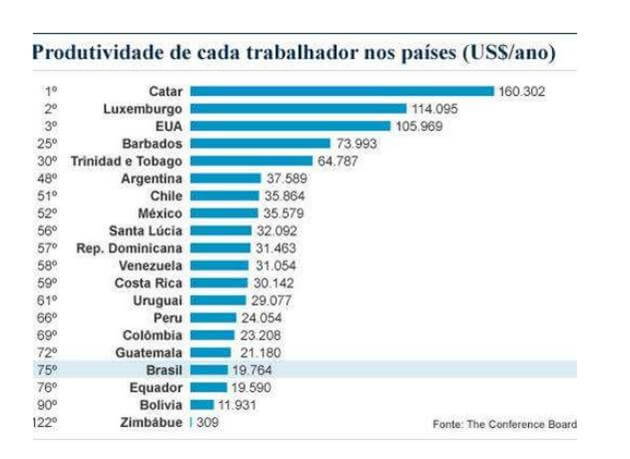
This definition of productivity is calculated based on how much each professional contributes to the GDP (Gross Domestic Product) in each country. Therefore, it is not surprising that Brazil is far from the countries with the highest productivity, ranking 75th in the world .
Check out the chart below to see each country's ranking in terms of worker productivity:
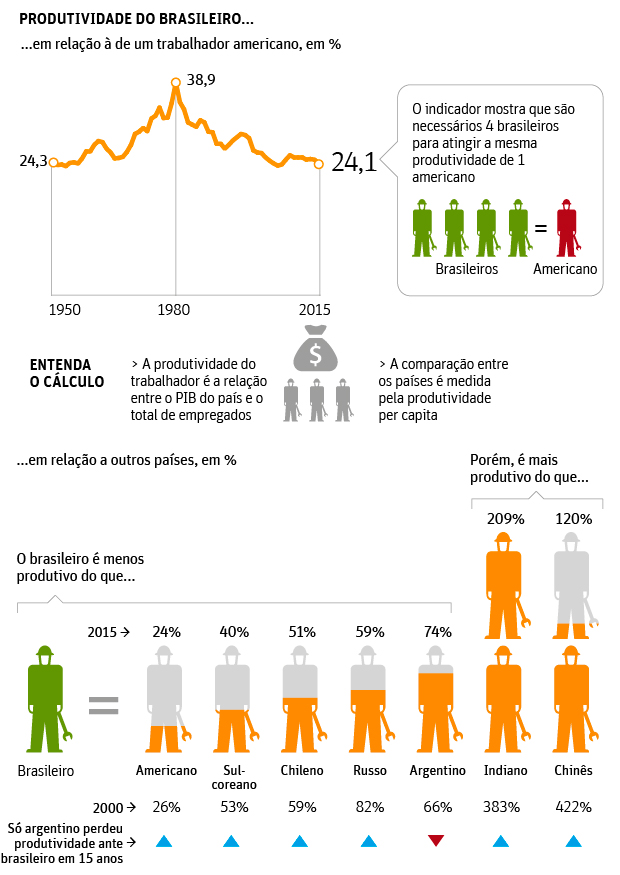
Even worse than this situation is the fact that Brazil has not progressed in terms of the productivity of its professionals. Compared to the United States, the gap is widening and approaching levels seen in 1950, as shown in this infographic from the Conference Board , an American organization that analyzes data from thousands of companies in more than 60 countries.
The chart also shows that Brazilian workers are still more productive than their Chinese and Indian counterparts.
According to experts, the low productivity rates in Brazil stem mainly from three factors:
- Low educational level and lack of technical qualifications among Brazilian professionals.
- Low level of resources in terms of equipment, machinery, and support structures.
- Economic inefficiency and infrastructure bottlenecks in the country
- Lack of interest from professionals in seeking better results.
The low level of education in Brazil is clearly one of the limiting factors for improving wealth creation in the country. Brazilians study for an average of 7 years, while in the US the average is 12 years of study, including higher education, in addition to the difference in the quality of education. It is no coincidence that South Korea is at the top of the list of the most productive countries, as it is one of the nations that invests the most in education in the world.
Similarly, investment in infrastructure, both by the private sector and the government, is still very low. Many companies do not invest in machinery and equipment and do not value creating a good work environment for their employees, which directly and negatively impacts team productivity and the company as a whole.
The lack of interest among professionals in seeking better results is also a determining factor in Brazil's low levels of productivity, as Brazilian professionals appear complacent and lack the willpower to improve and increase their performance in their work.
Analyzing the four factors separately, we can see that the first two are directly linked to company management practices and that it is possible to overcome this low productivity with an approach focused on employee training and adequate investment in machinery/equipment and a suitable work environment.
Therefore, it is up to companies to reverse the low average productivity of professionals in Brazil, through training and qualification practices for employees and investment in equipment and a work environment conducive to production and high performance.
However, professionals need to demonstrate an interest in increasing productivity and performance in the tasks assigned. Only in this way, resulting from a union between companies and professionals, is it possible to improve this Brazilian ranking.
Now, applying this analysis to the practice of strategy and management in companies, it becomes clear that it is possible to achieve productivity levels comparable to countries like the United States and South Korea. To do this, it is essential, first, to attract highly qualified professionals and invest in the ongoing training of the team.
In another comparison, in the US professionals receive an average of 120 hours of training per year, while in Brazil the average is only 30 hours .
Furthermore, it is essential to use management practices to increase team productivity ; some important practices are:
- Setting goals by team and collaborators.
- Emphasis on teamwork and internal communication.
- Explore IT resources, such as modern systems and equipment.
- Task management and results tracking
- Benefits and bonuses for employees based on results achieved.
Each of these measures aims to maximize the capacity of professionals and allow them to perform their tasks in the best possible way.
It is also important to emphasize that each company and team has unique characteristics, and it is up to managers to identify the most relevant aspects that should receive more attention regarding investment in the company's human capital.
In addition to investing in human capital, it is also necessary to invest in equipment and infrastructure. In this case, priorities should be aligned with the profile of each company; for example, industries need modern machinery, high-quality support equipment, and very well-defined processes.
In office environments, investment involves comfortable facilities and quality technology resources, such as high-performance equipment, modern management tools , and good quality internet.
Bringing this topic to the safer and more productive use of the internet in companies, which is one of the main objectives of the content on our blog and of Lumiun Tecnologia as a solution for this purpose, it is necessary for managers to understand how much a well-functioning network can contribute to the execution of tasks.
Even the importance of managing the internet so that the network is used productively, avoiding wasted team time and resources, prioritizing services and resources related to the company's activities. To learn more, contact our customer service .
In conclusion, the most important thing is for companies and managers to take responsibility for continuously seeking to maximize their productivity, and for that, it is essential to invest in human capital and infrastructure.
In fact, this investment strategy is common among the fastest-growing and most developed companies in the country, since in an increasingly competitive market, the differentiating factor often becomes the company's efficiency compared to its competitors.
Did you enjoy this content? Share your experience or perspective on this topic with us. How do you see your company addressing the issue of employee productivity? What more can be done to reach the level of the most productive countries in the world?


7 comments
Comments closed