DNS security is the set of technologies that monitors and filters DNS queries to identify and block access to malicious, suspicious, or unauthorized domains before a connection is established. In businesses, this layer of protection helps control internet access and reduce risks related to phishing, malware, ransomware , and other threats that rely on communication with malicious domains.
DNS plays a role in locating websites, cloud systems, services, and other resources available on the internet. Therefore, DNS queries can also function as a strategic point of control and security for the corporate network, allowing for the application of access policies and the identification of potentially dangerous connections.
In 2026, DNS also gained relevance as part of network security strategy. NIST highlights the use of DNS as a point of application for security policies and as a source of information that can help identify potentially malicious activity on a network.
In this article, you will understand what DNS security is, how it works in practice, what risks it can help reduce, and why this technology has become an important layer of network security in companies.
What is DNS security?
DNS Security is the application of protection mechanisms to the domain name resolution process. DNS , short for Domain Name System , is responsible for associating names like site.com.br with the IP addresses used by devices to locate servers and services on the internet.
In a corporate network, every time a device needs to access a domain, a DNS query is performed to determine where that connection should be directed. With a DNS security layer, this query can be analyzed before access to the domain is allowed.
The solution can check information such as the domain's reputation, its rating, and the policies defined by the company. When the query is associated with a malicious, suspicious, or unauthorized domain, access may be blocked. When the domain is considered secure and complies with the organization's policies, the resolution continues normally.
What is the difference between regular DNS and secure DNS?
A conventional DNS service's main function is to resolve domain names, while a DNS security solution adds mechanisms for analysis, filtering, and policy enforcement to this process.
In practice:
- Conventional DNS: translates domain names into IP addresses to allow the device to find the requested service.
- DNS security: in addition to performing this resolution, it analyzes queries and can block domains according to security information and organizational policies.
This difference transforms DNS into more than just an infrastructure component: it can also function as a control point for the security and use of the corporate internet.
Why use DNS security on a corporate network?
Using DNS security allows the IT team to centrally apply access policies and monitor queries made by protected devices.
Depending on the solution, it's possible to create rules by content categories, users, groups, devices, locations, or times. This allows you to combine protection against malicious domains with internet access control, without relying exclusively on individual settings on each device.
DNS security also complements other layers of the security infrastructure. Firewalls, endpoint protection solutions, multi-factor authentication, and employee training continue to play different and important roles. Secure DNS adds another opportunity to identify and block potentially dangerous connections.
NIST itself recognizes DNS as a relevant point for the application of security policies and for the identification of possible malicious activities on networks. In its 2026 revision of the Secure Domain Name System (DNS) Deployment Guide, the organization reinforces the importance of DNS-related security practices in corporate environments.
How DNS security works
DNS security works by adding a layer of analysis and filtering to the name resolution process. Instead of using only the default DNS from the internet provider or local infrastructure, the company directs device queries to a DNS service that applies security rules and access policies.
With each query, the service can check the domain's reputation and rating, as well as consult the policies configured by the organization. If the domain poses a risk or is blocked by a rule, the request may be interrupted before the device establishes communication with the destination.
How does DNS blocking work?
The process can be divided into five stages:
- The device requests access to a domain.
The user attempts to access a website, system, or service using a domain name. - The DNS query is routed to the protected DNS server.
Instead of directly using a conventional DNS resolver, the request goes through the service configured by the company. - The domain is analyzed.
The service verifies information such as reputation, category, threat intelligence, and access policies defined by the organization. - The query is either allowed or blocked.
If the domain is associated with a threat or is prohibited by company policies, the service may prevent resolution and return a blocking response. - The connection continues when the domain is allowed.
If the query complies with the security rules, the IP address is returned and the device can proceed with the connection.
What happens when a domain is blocked?
When a query is identified as potentially dangerous or unauthorized, the DNS security service may prevent the device from obtaining the necessary resolution to access that domain.
For the user, this typically appears as a page or message informing them that access has been blocked. For the IT team, the event can be logged in reports, allowing them to identify which device made the request, which domain was requested, and which rule determined the block, according to the resources available in the solution.
This mechanism allows the company to not only react to a threat after it reaches the device. DNS also functions as a preventive control point, capable of interrupting certain connections before access to the domain occurs.
Does DNS security affect internet speed?
DNS resolution is a normal part of accessing services on the internet, so the performance of the service used is important. A secure DNS solution should maintain low latency and an infrastructure appropriate to the organization's location and query volume.
In practice, the impact depends on factors such as the distance to the DNS servers, the quality of the infrastructure, processing capacity, and network configuration.
Therefore, when choosing a secure DNS solution, performance and availability should also be part of the evaluation criteria, in addition to security features.
DNS over HTTPS (DoH) and DNS over TLS (DoT): how do they work?
In addition to filtering and policy enforcement, DNS security also involves protecting the communication between the device and the service responsible for domain name resolution.
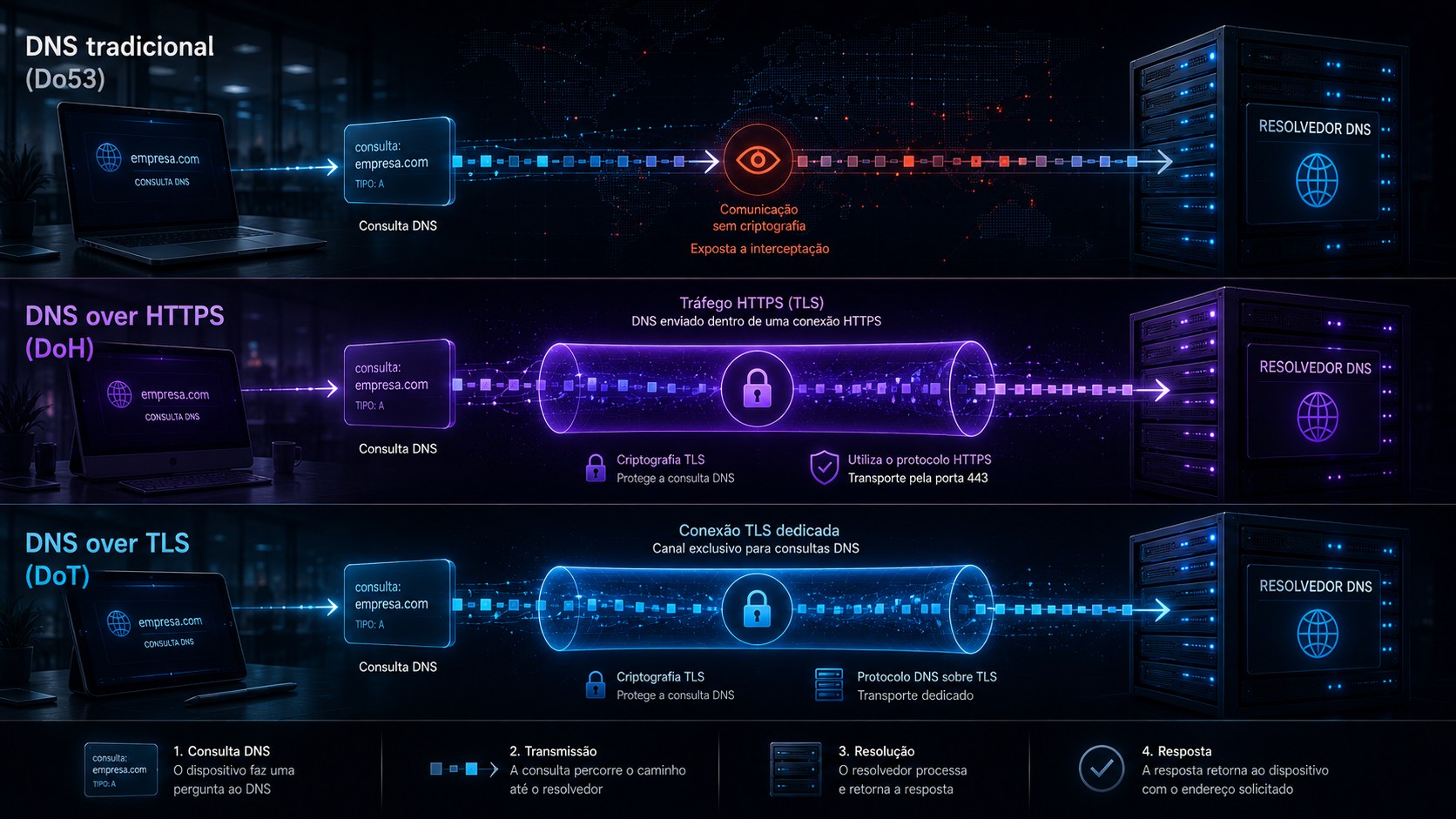
In traditional DNS, known as DNS53 or Do53, queries are typically performed through port 53, without the same encryption layer offered by newer protocols. Technologies such as DNS over HTTPS (DoH) and DNS over TLS (DoT), , use encryption to protect DNS queries and responses during traffic between the client and the resolver.
What is DNS over HTTPS (DoH)?
DNS over HTTPS, or DoH, is a protocol that sends DNS queries over HTTPS connections protected by TLS.
In practice, this helps protect the confidentiality of DNS queries during transmission. DoH uses the HTTP protocol over TLS and typically operates on port 443.
Since it uses the same port widely employed by HTTPS traffic, its implementation needs to be considered within the company's security strategy. Applications and browsers configured to use an external resolver, for example, can bypass the DNS service defined by the organization if there is no proper configuration.
What is DNS over TLS (DoT)?
DNS over TLS, or DoT, is a protocol that uses TLS to encrypt DNS communication between the client and the resolver.
While DoH transports DNS queries using HTTPS, DoT uses a dedicated TLS connection for this traffic, typically over TCP port 853.
The goal of both protocols is similar: to add encryption to DNS communication to reduce the risk of interception and exposure of queries during transmission.
What is the difference between DoH and DoT?
The main difference lies in how DNS queries are transported:
- DoH: uses HTTP over TLS, typically on port 443;
- DoT: uses TLS directly for DNS traffic, typically through port 853;
- Traditional DNS (Do53): uses the conventional DNS protocol, usually via UDP or TCP port 53.
The choice between protocols depends on the infrastructure, devices, and security architecture used by the company. The most important thing is to ensure that the implementation of encrypted DNS is integrated into the organization's strategy for controlling, monitoring, and enforcing policies.
How do I add protection and encryption to my company's DNS?
To add more security to DNS, the company can use a protected DNS service that combines domain filtering, policy enforcement, query monitoring, and support for encrypted DNS protocols, according to the infrastructure needs.
Lumiun Lumiun DNS, for example, offers support for traditional DNS protocols, DNS over HTTPS (DoH), and DNS over TLS (DoT). This allows the organization to use different ways to route its DNS queries according to the compatibility of equipment, servers, firewalls, and devices used in the environment.
In addition to protocols, Lumiun DNS allows you to apply access policies and view information about queries made by protected devices. Therefore, the company can use DNS not only for name resolution, but also as a point of protection, control, and visibility over internet access.
What risks does DNS security reduce?
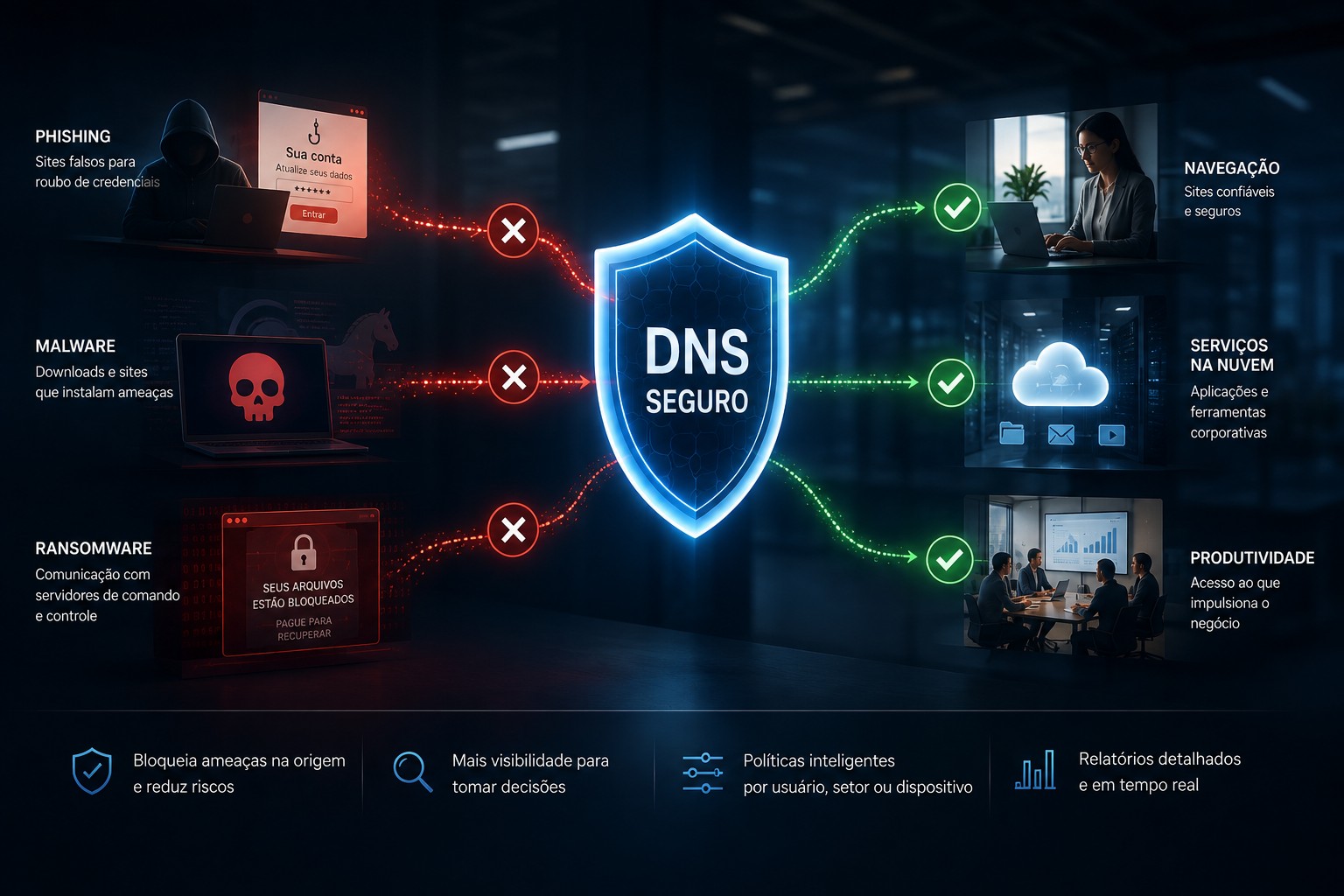
DNS security can help reduce various risks related to accessing malicious domains and communication between devices and servers on the internet. Among the main risks are phishing, malware, ransomware, and connections to command and control (C2) servers.
The blocking occurs based on the analysis of DNS queries. When a domain is identified as malicious, suspicious, or incompatible with the organization's policies, the solution may prevent the device from obtaining the necessary resolution to establish that connection.
This protection model is especially relevant because it allows action to be taken before the user reaches the domain content. NIST highlights Protective DNS as an additional layer of security capable of blocking malicious traffic, enforcing organizational policies, and generating query data to support incident investigation and response.
How DNS security prevents phishing
DNS security can block access to domains identified as malicious or associated with phishing campaigns.
In a phishing, the criminal typically tries to trick the victim into clicking a link that leads to a fake page. The website may impersonate a bank, cloud service, corporate system, or other well-known brand to induce the user to provide credentials and other information.
When the domain used in the scam has already been identified by a security solution, the DNS query can be blocked before the page loads.
This mechanism adds an important layer of protection, mainly because phishing exploits human interaction. Even when an employee clicks on a malicious link, the protected DNS can prevent the device from accessing the blocked domain.
The challenge, however, is that the domains used in phishing campaigns are constantly changing. Recent research shows that criminals continue to register new domains specifically for phishing operations, which reinforces the importance of threat intelligence mechanisms and continuous updating of blocklists.

How DNS security reduces the risk of malware and ransomware
DNS security can reduce the risk of malware and ransomware by blocking queries to domains associated with the distribution of malicious files or communication with servers used by attackers.
After an infection, certain types of malware may attempt to establish communication with an infrastructure controlled by criminals. This communication can be used to receive commands, download additional components, send information, or maintain control over the device.
When the domain used in this communication is known and classified as malicious, DNS blocking can interrupt this step of the connection.
This does not mean that DNS security eliminates malware or replaces an endpoint protection solution. The role of DNS is to add a layer of defense capable of preventing certain communications associated with the threat.
For this reason, DNS protection works best as part of a defense-in-depth strategy, combined with firewalls, endpoint protection, vulnerability management, backups, and other security measures.
What is DNS hijacking and how does DNS security help reduce this risk?
DNS hijacking occurs when an attacker manages to manipulate name resolution or DNS-related configuration to redirect users to destinations controlled by them.
The goal might be to redirect the victim to a fake page, intercept communication, or alter the destination of a request without the user immediately noticing.
It's important to differentiate this type of threat from simply blocking malicious domains. solution DNS filtering alone does not prevent all forms of DNS hijacking. Protecting the DNS infrastructure itself, using secure configurations, and mechanisms like DNSSEC may be necessary depending on the scenario.
NIST recommends various controls to protect DNS infrastructure and services, including measures aimed at the integrity, availability, and security of name resolution.
Therefore, in a corporate strategy, DNS security should be understood as a set of mechanisms that may include Protective DNS, filtering, monitoring, infrastructure protection, and DNSSEC, according to the organization's needs.
Why DNS security is strategic for businesses
DNS security has become an increasingly important layer in protecting corporate networks because DNS is present in a large part of the communication carried out by devices to locate services and resources on the internet.
By using DNS as a control point, companies can combine protection against malicious domains, enforcement of access policies, and visibility into queries performed on the network.
This approach has gained even more relevance in a scenario where companies are increasingly using cloud services, connected devices, and internet-accessible applications. At the same time, attacks continue to use online domains and infrastructure to distribute malware, carry out scams, and establish communication with compromised systems.
In 2026, NIST reinforced this importance by publishing the third revision of the Secure Domain Name System (DNS) Deployment Guide. The document highlights DNS as a point that can be used to apply security policies, block malicious traffic, and collect information that helps identify potential suspicious activity.
What are the benefits of DNS security for businesses?
Blocking malicious domains
DNS security can prevent devices from accessing domains identified as malicious or associated with known threats. This creates a preventative layer that can stop certain connections before the user reaches the website content.
Reduction of the exposure surface
By blocking categories of domains and destinations considered risky, the company reduces the chances of its users and devices establishing connections with potentially malicious infrastructure.
DNS doesn't eliminate other forms of attack, but it can reduce a portion of the connections that pose a risk to the organization.
Visibility over DNS queries
Query logs can provide important information to the IT and security team, such as which domains are being accessed, which requests were blocked, and which devices are performing specific queries, depending on the capabilities of the solution used.
This visibility can help in identifying out-of-the-ordinary behavior and also provide information for security investigations.
Centralized application of access policies
Instead of configuring rules individually on each device, a DNS security solution can allow the organization to apply policies centrally.
Depending on the solution, these policies may consider users, groups, devices, locations, times, or content categories.
This simplifies the administration of the corporate internet and allows the rules to be adapted to the needs of different areas of the company.
Complement to other security layers
DNS security is not a replacement for firewalls, endpoint protection, multi-factor authentication, or other cybersecurity tools.
Its role is to complement these technologies, creating a defense-in-depth strategy in which different controls operate at different points in the environment.
Why is DNS a strategic point of control?
One of the main advantages of DNS for corporate security is its position in the communication flow.
Before accessing a domain, the device typically needs to discover which address corresponds to that name. This creates an opportunity to analyze the request and apply a policy before the connection to the destination is established.
For this reason, DNS can simultaneously function as a name resolution infrastructure, a point of policy enforcement, and a source of information for security monitoring.
For IT teams, this means that DNS security can contribute both to threat prevention and to the governance of internet use within the organization.
How to implement DNS security in your company
Implementing DNS security begins with defining which devices, networks, and users need to be protected and which access policies should be applied. The configuration may vary depending on the company's infrastructure and the solution used, but some steps are fundamental to structuring this layer of protection.
1. Define security and access policies
Before setting up the service, the company needs to define which types of domains and content categories should be blocked or allowed.
Policies may consider, for example:
- Domains identified as malicious or suspicious;
- Content categories that are incompatible with the company's usage policy;
- Services that should not be accessed in certain sectors;
- Different rules for groups, devices, locations, or times.
The goal is to balance safety and operation, avoiding blockages that hinder access to tools necessary for the job.
2. Direct queries to a secure DNS service
After defining the policies, it is necessary to configure the devices or network infrastructure to use the chosen DNS service.
Depending on the company's solution and architecture, this configuration can be performed directly on network equipment, servers, devices, or through other query routing mechanisms.
The most important thing is to ensure that the endpoints requiring protection use the configured service and that the policies are applied consistently.
3. Create policies according to each need
Not all users and departments within a company have the same internet access needs.
Therefore, when the solution allows, it is advisable to create specific policies for different groups. A finance team, for example, may have different needs than a development team or the devices used in customer service areas.
This segmentation allows for the application of controls that are more appropriate to the context of each group, instead of using a single rule for the entire organization.
4. Track consultations and blocks
DNS query reports and logs help the IT team monitor policy performance and identify attempts to access potentially dangerous domains.
This monitoring can reveal, for example:
- recurring attempts to access malicious domains;
- devices exhibiting unusual behavior;
- Frequently blocked categories;
- Unjustified blocks that require policy adjustments.
The logs can also provide useful information for security investigations and incident analysis. NIST highlights DNS as a source of information about potentially malicious activity and recommends monitoring and security practices appropriate to the role DNS plays in the organization.
5. Keep policies and protections up to date
Implementation doesn't end after the initial setup. New domains are continually created, threats evolve, and the company's own needs may change.
Therefore, it is important to periodically review the policies applied, monitor the recorded events, and use a solution that keeps your identification and protection mechanisms up to date.
The most recent NIST publication on secure DNS deployment also reinforces the need to protect the DNS protocol and infrastructure, mitigate risks related to misuse or compromise, and utilize DNS as an additional layer within a defense-in-depth strategy.
6. Combine DNS security with other layers of protection
DNS security is most effective when it's part of a broader cybersecurity strategy.
It should complement other measures adopted by the company, such as firewalls, endpoint protection, multi-factor authentication, vulnerability management, backups, and employee training.
Each layer has a different function. DNS can act as a control point for certain queries and connections, while other technologies protect different parts of the infrastructure.
This combination reduces reliance on a single security mechanism and strengthens the defense-in-depth strategy.
Frequently asked questions about DNS security
What is DNS security?
DNS security is a layer of protection that analyzes and filters DNS queries to block access to malicious, suspicious, or unauthorized domains before the device establishes communication with the destination.
In companies, it can be used to enforce internet access policies, block content categories, and monitor queries made by network devices.
What is the purpose of DNS security in companies?
DNS security serves to reduce the risk of connections to domains associated with threats and to control internet access in accordance with company policies.
It can help block domains used in phishing campaigns, malware distribution, and communication with malicious infrastructure, as well as provide visibility into blocked queries and access attempts.
How can I implement DNS security in my company?
To implement DNS security, it is necessary to configure the network or devices to use a secure DNS service and define the company's access policies. Lumiun Lumiun DNS is one of the available solutions, allowing you to apply filters and access policies and monitor queries performed on the network.
Does DNS security replace firewall or antivirus software?
No. DNS security does not replace firewalls, antivirus software, or other endpoint protection solutions.
Each technology operates at different points in the infrastructure. DNS security can block certain queries before the device connects to the domain, while other tools act on network traffic, files, processes, behaviors, and other stages of a potential attack.
Therefore, protected DNS should be used as a complementary layer within a defense-in-depth strategy.
Does DNS security slow down browsing?
DNS security adds an analysis step to the name resolution process, but a solution with adequate infrastructure should maintain low latency and high availability.
The impact on internet access depends on factors such as the location and capacity of the DNS servers, the solution architecture, the network configuration, and the volume of queries. Therefore, performance should also be considered when evaluating a DNS security solution.
DNS security: does it block ransomware?
DNS security can help reduce the risk associated with ransomware by blocking domains associated with the distribution of malicious files or the communication used by certain threats.
However, it does not eliminate ransomware or replace other security measures. The most effective protection combines different controls, such as DNS security, endpoint protection, backups, vulnerability management, and user training.
What is the difference between regular DNS and secure DNS?
A standard DNS server's main function is to resolve domain names and return the address needed to locate a service on the network.
DNS security adds analysis, filtering, and policy enforcement to this process. In this way, certain queries can be blocked based on domain reputation, threat intelligence, or rules defined by the company.
Is it possible to use DNS security across the entire company?
Yes. Protection can be applied according to the infrastructure and solution chosen, covering networks, devices, users, or different locations within the organization.
The implementation method depends on the architecture used. Therefore, it is important to assess how DNS queries will be routed and which points in the infrastructure need to be protected.
DNS security as part of corporate protection
DNS security is a layer of protection applied to the name resolution process, capable of analyzing queries and blocking access to malicious, suspicious, or incompatible domains that violate company policies.
By operating at a strategic point in internet communication, it can help reduce risks related to phishing, malware, and other threats that depend on accessing or communicating with malicious domains. In addition to protection, DNS can also contribute to the application of access policies and visibility into network connections.
However, DNS security should not be used as an isolated mechanism. Firewalls, endpoint protection, multi-factor authentication, and other controls remain important for protecting different points in the infrastructure. The role of DNS is to complement these layers within a defense-in-depth strategy, an approach reinforced by NIST in its 2026 publication on secure DNS deployment.
For businesses, this means transforming an essential part of the internet infrastructure into yet another control point. With the right strategy and solution, DNS security can combine protection against malicious domains, access control, and visibility into network activity, contributing to a broader and more integrated security approach.